Rubber coated magnets solve the two problems bare steel mounting magnets create: they mark the surfaces they hold, and they slide off smooth vertical steel. A neodymium core in a steel housing, jacketed in a moulded rubber coat — that combination holds painted panels, glass and gel-coat without leaving a scratch, grips sideways two to three times better than bare steel, and mounts through whatever hardware your application already uses. Sign fitters, film crews, vehicle-accessory brands and fixture builders specify them for exactly these three properties, in that order.
This page is the family overview of our rubber coated magnets: three mounting styles — female-thread pots, external-stud pots and rubber coated hooks — fifteen sizes from Ø22 mm to Ø88 mm, 2 to 26 kgf measured pull, $2.25 to $13.20. Below the family table you will find what the rubber actually does (and what it honestly costs), the grip arithmetic behind "it doesn't slide", and a four-step chooser that lands on the right variant in one pass. Each style then has its own detail page with the full spec table.
If you already know that force alone matters and the surface is bare steel, bare pots beat rubber coated magnets on pull per gram — the pot magnet range is where to look.
Every magnet in this family shares one four-part section; the styles differ only in what emerges from the back face:
Because the jacket covers the working face of all rubber coated magnets, the rubber is what the application actually feels: rubber on painted steel, rubber on glass, rubber on a car panel. That is a different tribological situation from steel-on-steel, and it is the reason every style in this family behaves unlike any bare pot of the same rating.
Three jobs, in order of how often they matter:
The honest cost: the rubber layer adds an air gap at the working face, so vertical pull is lower than a bare pot of the same diameter would deliver. Rubber coated magnets trade peak force for grip, protection and repeatability — and for most mounting applications that is exactly the right trade.
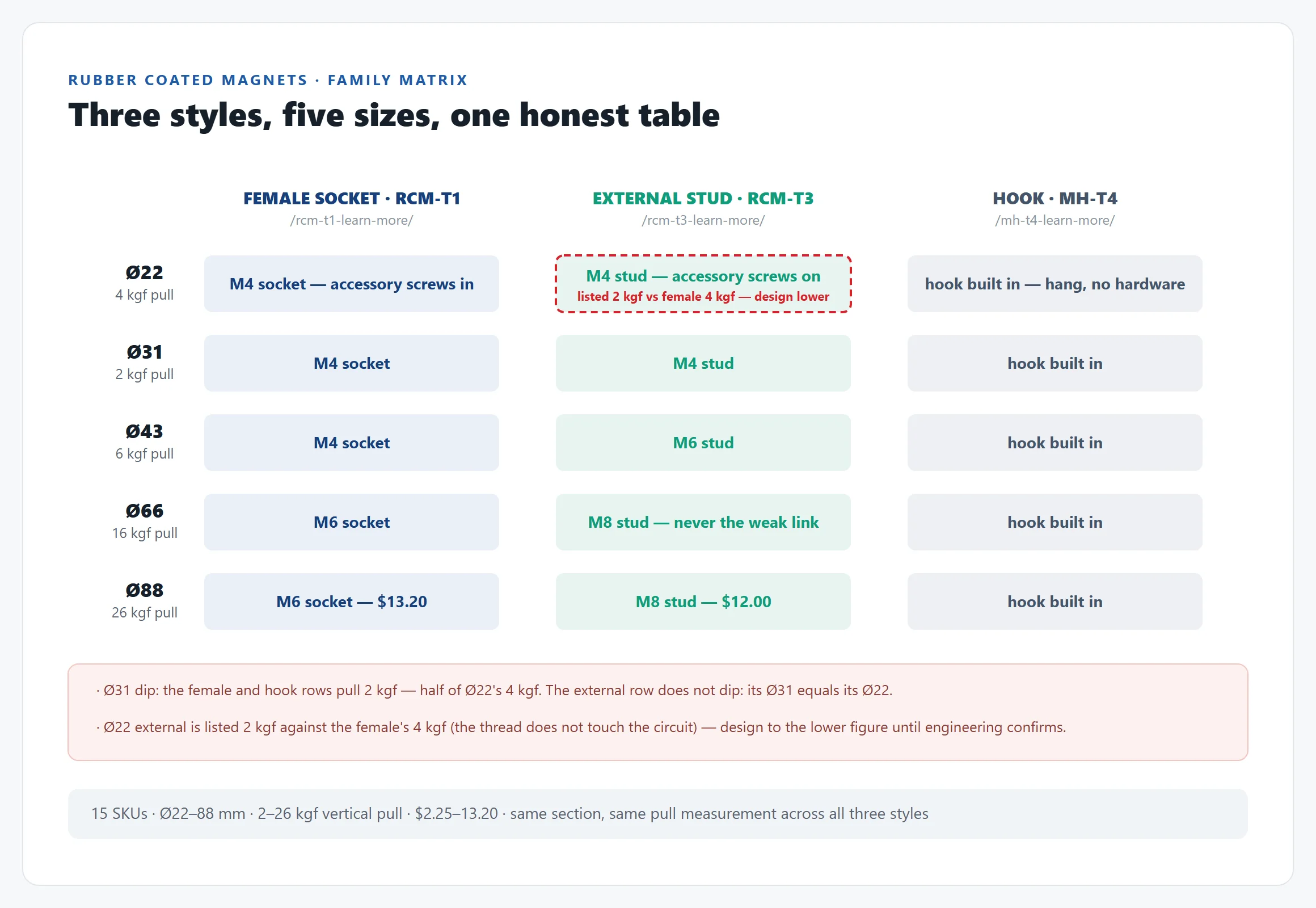
All fifteen SKUs across the rubber coated magnets family share the same section and the same pull measurement, so the rows compare directly across styles:
| Diameter | Pull | Female thread (RCM-T1) | External stud (RCM-T3) | Hook (MH-T4) |
|---|---|---|---|---|
| Ø22 mm | 4 kgf | M4 socket | M4 stud — listed 2 kgf, see note | hook built in |
| Ø31 mm | 2 kgf | M4 socket | M4 stud | hook built in |
| Ø43 mm | 6 kgf | M4 socket | M6 stud | hook built in |
| Ø66 mm | 16 kgf | M6 socket | M8 stud | hook built in |
| Ø88 mm | 26 kgf | M6 socket | M8 stud | hook built in |
Price range across the family: $2.25 to $13.20. One footnote belongs in every honest reading of this table: the Ø22 external-stud version is catalogued at 2 kgf against the female's 4 kgf — the thread does not touch the magnetic circuit, so we advise designing to the lower figure until engineering confirms the row. And note the external range has no Ø31 dip: its Ø31 pulls the same 2 kgf as its Ø22, while the female and hook rows genuinely dip.
Reading notes: the socket range carries M4/M4/M4/M6/M6; the stud range steps up faster with M8 on both large sizes — a stud loads through a nut on your side, where the heavier thread costs nothing, so on those two bodies the bolt is never the weak link. The hook style needs no hardware at all: the hook is part of the assembly, which is why it is the go-to for doors, beams and cable runs.
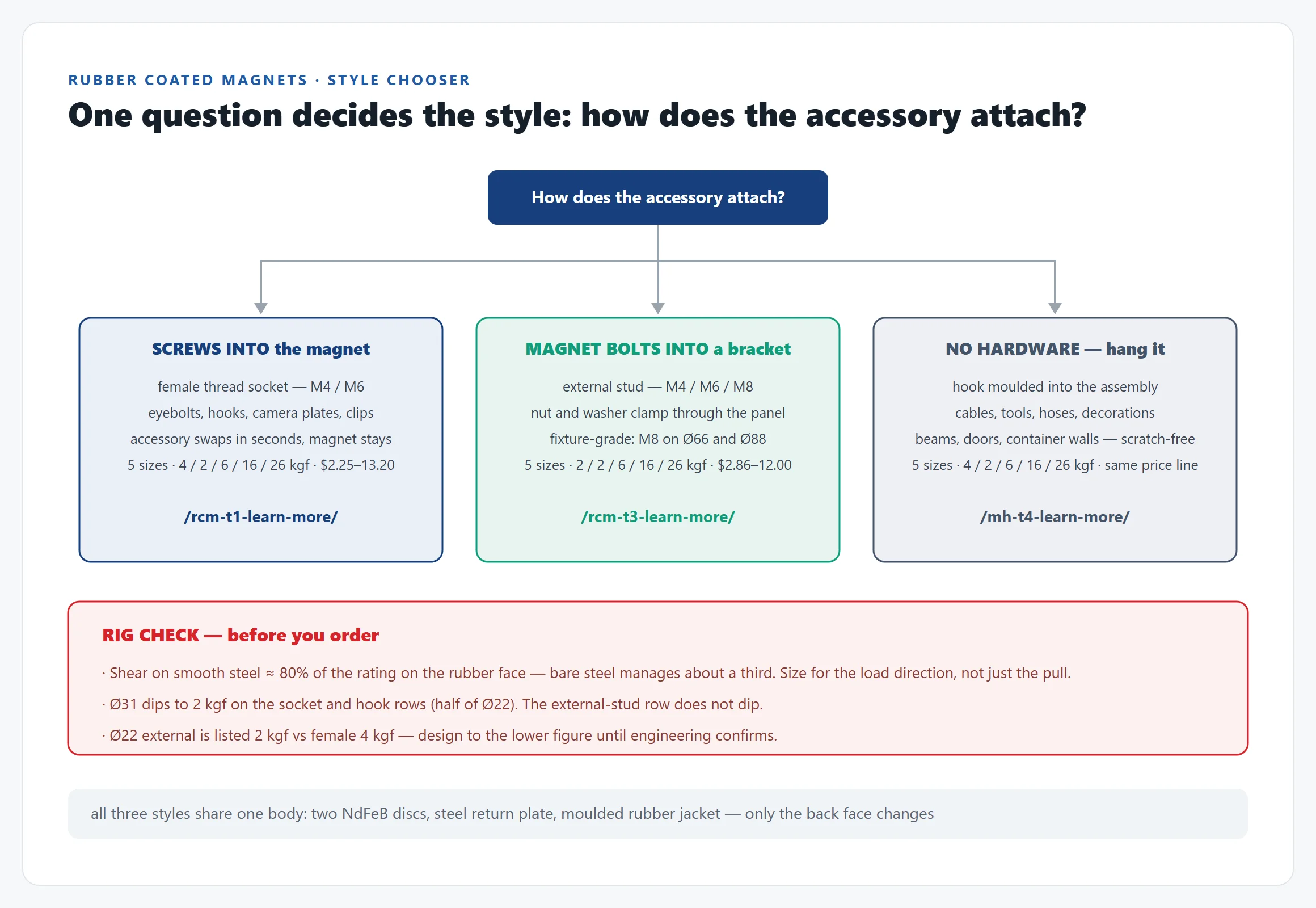
The three styles of rubber coated magnets differ only at the back face — and that face decides everything:
Beyond these three, the rubber coated category also lists rubber coated disc magnets, block magnets and countersunk versions for assemblies that need a flat or countersunk fixing instead of a thread.
Beyond the fifteen stock rubber coated magnets we build OEM programmes for signage brands, vehicle-accessory makers and fixture builders: custom diameters and jacket colours, higher-temperature grades, alternative thread standards, longer studs, hook geometries, and pre-assembled accessory kits. Because the magnets, plate, jacket and inserts are all produced in-house, a custom assembly is a drawing and a quantity — start at custom magnets or contact us directly.
Q1: What is a rubber coated magnet? A: A magnetic assembly that combines powerful neodymium discs, a steel return housing, and a protective rubber jacket. The rubber protects contact surfaces while improving grip and reducing slipping — the defining trait of all rubber coated magnets.
Q2: Why choose a rubber coated magnet instead of a standard pot magnet? A: Surface protection and friction. Rubber coated magnets are the choice on painted, polished or delicate surfaces where scratches must be avoided and sliding resistance matters more than peak pull.
Q3: Do rubber coated magnets have the same holding force as standard pot magnets? A: Direct pull is somewhat lower because the rubber adds an air gap at the working face. Sideways, the opposite: the rubber's friction holds roughly 80% of the rating where bare steel manages about a third.
Q4: What are rubber coated magnets commonly used for? A: Vehicle accessories, lighting, cameras and GPS mounts, signage, exhibition displays, industrial fixtures — anywhere a strong, removable, non-marking mount is needed.
Q5: Can rubber coated magnets be used outdoors? A: Yes. The jacket shields the assembly from moisture and minor impacts better than plating alone; rinse with fresh water after marine use and inspect the face for cuts.
Q6: What thread types are available? A: Three mounting interfaces: tapped sockets (female, M4/M6) on RCM-T1, external studs (M4–M8) on RCM-T3, and built-in hooks on MH-T4 — plus countersunk and flat variants in the category.
Q7: Will rubber coated magnets scratch painted surfaces? A: Under normal use, no — that is what the rubber prevents. Keep the face clean: a trapped steel filing, not the rubber, is what would mark the surface.
Q8: Can rubber coated magnets support heavy loads? A: Yes — the family tops out at 26 kgf vertical pull on the Ø88, and roughly 20.8 kgf sideways on smooth steel. Match the load direction to the shear rule and size up a diameter when in doubt.
Q9: Can rubber coated magnets be customized? A: Yes. Custom rubber materials, thread sizes and standards, pull forces, jacket colours, longer studs and OEM branding are all standard options for us.
Q10: What rubber materials are available? A: TPE and other durable elastomers selected for wear resistance, weather resistance and long service life; material choice is part of every custom quotation.
Q11: What is the maximum operating temperature of rubber coated magnets? A: 80 °C continuous with standard neodymium grades, jacket included. Higher-temperature magnet grades inside the same jacket are a custom order — relevant near engines and machinery, not for rubber coated magnets on office glazing.
Q12: How do I choose the right rubber coated magnet? A: Work the four steps above: attachment direction first, then honest pull (vertical vs shear), then the surface, then the thread. If two styles both fit, the contact us route gets you an engineering recommendation the same day.
Three styles, fifteen sizes, $2.25 to $13.20 — and every pull figure measured the same way, so the comparison across rubber coated magnets is honest. Browse the rubber coated magnets category for stock, or contact us with the surface you need to hold and the hardware you need to mount. Engineering answers the same day — including the advice to size down when a bigger footprint tempts you.