Every neodymium magnet datasheet ends its grade code with a letter — N42M, N48H, N45SH — and that letter quietly decides whether your assembly survives in the application or loses its force in the first heat cycle. The letter is the neodymium magnet temperature grade, and choosing it wrong is the most expensive selection mistake in NdFeB sourcing: a standard N-grade neodymium magnet that creeps past 80 °C will not just weaken for a moment, it will demagnetize permanently.
This guide explains neodymium magnet temperature ratings the way a buyer needs them: what each grade guarantees, how much pull force you actually lose as things heat up, what the letter costs, and which grade fits motors, sensors, aerospace actuation and high-temperature process equipment. By the end you will be able to read a grade code like N38SH and know exactly what it promises at 150 °C — and what it does not.
Neodymium magnets respond to heat in two distinct ways, and separating them is the key to every neodymium magnet temperature decision:
Above all of this sits the Curie point. Sintered NdFeB loses ferromagnetism entirely at its Curie temperature of 310–370 °C, which is why no neodymium grade is rated anywhere near it — the practical neodymium magnet temperature ceiling is set by coercivity, not by the Curie point. For the underlying physics, see our explainer on Curie temperature and operating temperature, and for the material science background the Wikipedia article on neodymium magnets covers the crystallography in depth.
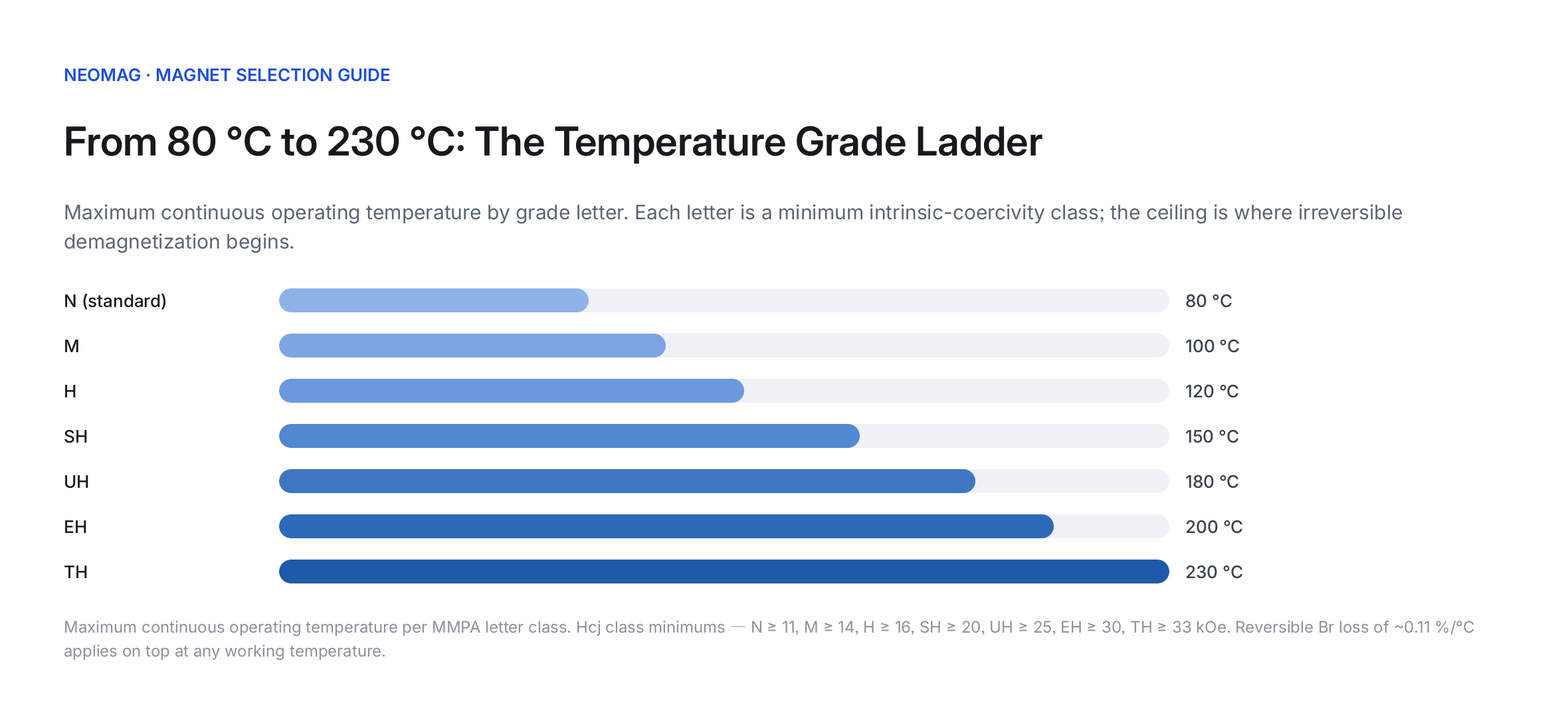
The letter suffix defines a minimum intrinsic coercivity class, and the industry maps each class to a maximum continuous operating temperature. Seven classes cover the standard neodymium magnet temperature range:
| Grade code | Min. Hcj (typical) | Max operating temp | Curie range | Relative cost | Typical duty |
|---|---|---|---|---|---|
| N (no letter) | ≥ 11 kOe | 80 °C | 310–370 °C | 1.0× | Indoor electronics, sensors, displays |
| M | ≥ 14 kOe | 100 °C | 310–370 °C | ~1.1× | Household motors, small pumps |
| H | ≥ 16 kOe | 120 °C | 310–370 °C | ~1.15× | Automotive accessories, power tools |
| SH | ≥ 20 kOe | 150 °C | 310–370 °C | ~1.3× | EV motors, industrial drives |
| UH | ≥ 25 kOe | 180 °C | 310–370 °C | ~1.5× | Under-hood and compressor systems |
| EH | ≥ 30 kOe | 200 °C | 310–370 °C | ~1.8× | Aerospace actuation, downhole tools |
| TH | ≥ 33 kOe | 230 °C | 310–370 °C | ~2.0×+ | Specialty process and defense builds |
(Infographic placement: temperature grade ladder chart, 30-neodymium-magnet-temperature-grades.png)
Two reading notes on the table. First, the Hcj minimums that anchor each neodymium magnet temperature class follow the common MMPA conventions; individual manufacturers publish slightly different floors, so treat the kOe values as class boundaries rather than guarantees. Second, the cost multiples are indicative for mid-size sintered parts — the premium comes from dysprosium and terbium additions that raise Hcj, and both elements are priced well above iron.
A full NdFeB grade is number plus letter: in N42SH, the number is the maximum energy product class (see our N35 vs N42 vs N52 comparison for that half of the code), and the suffix SH is the neodymium magnet temperature class — here, 150 °C continuous. The two halves are independent: you can order the same 42 MGOe energy level as N42, N42M, N42SH or N42UH, with the magnet's Br essentially unchanged and the coercivity climbing with each letter.
One consequence surprises many buyers: a higher number does not survive heat better. N52 and N35 lose force at the same −0.11 %/°C rate, and high-energy grades actually sit closer to the demagnetization knee because their Hcj is comparatively low. At elevated temperature, a well-chosen N38SH can outperform an N52 that was picked for its headline number. Our magnet grades explained guide covers the number half in detail, and the N52 magnet guide shows where the strongest grade fits.
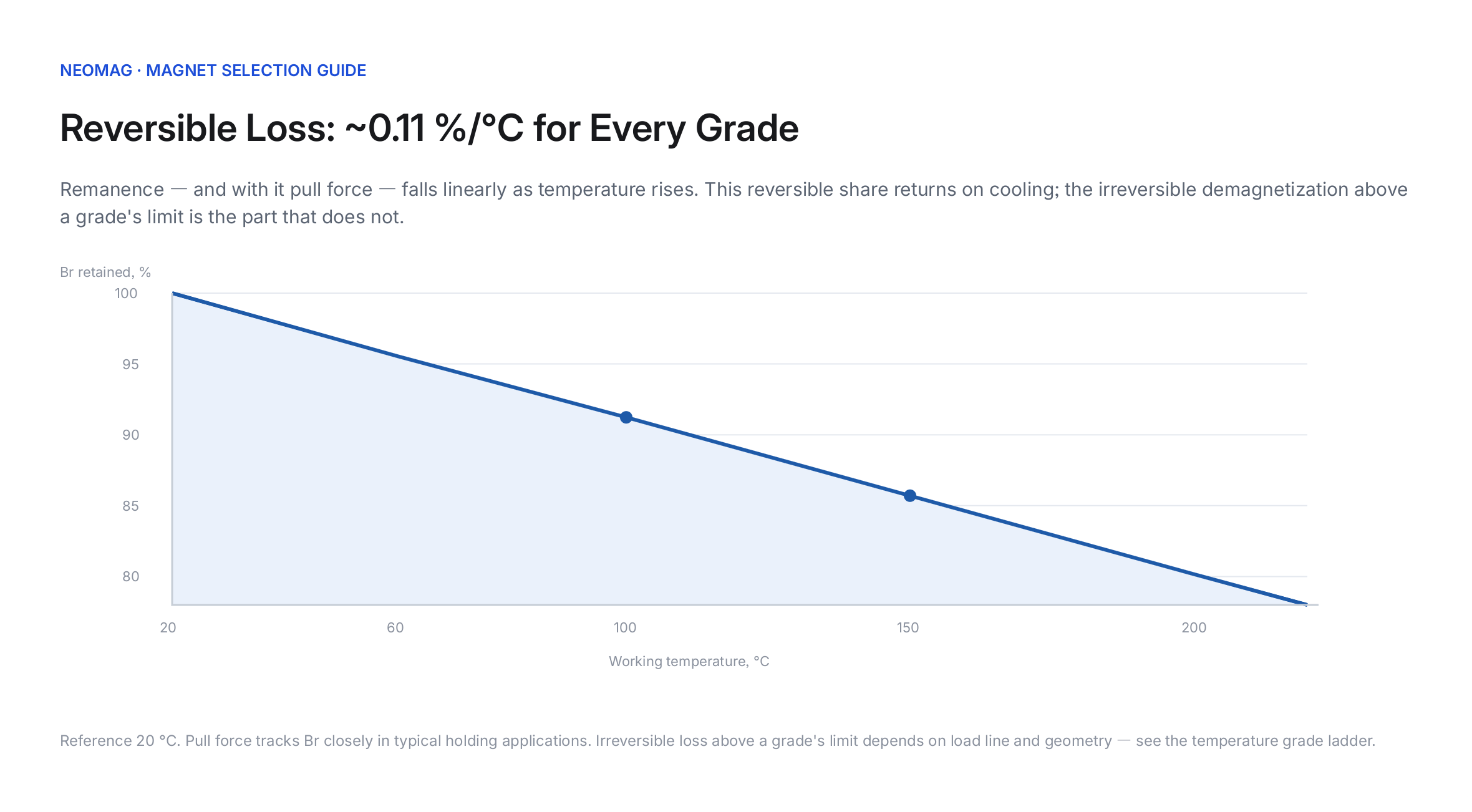
The reversible part is simple arithmetic, and it applies equally across the whole neodymium magnet temperature table. Br falls ~0.11 %/°C from its 20 °C reference, and in a typical holding application pull force tracks Br closely, so a magnet rated 10 kgf at room temperature delivers roughly:
| Working temperature | Approximate force retained (all grades, reversible) |
|---|---|
| 60 °C | ~95.6 % |
| 100 °C | ~91.2 % |
| 150 °C | ~85.7 % |
| 200 °C | ~80.2 % |
(Infographic placement: remanence derating curve, 31-neodymium-magnet-temperature-derating.png)
The irreversible part is why the table's "max operating temp" column exists, and it depends on more than the thermometer. Demagnetization risk at temperature is driven by the magnet's load line — its geometry (length-to-diameter ratio), the air gap it works across, and any reverse fields from coils or adjacent poles. A thick, short pot magnet on steel has a stiff load line and tolerates its grade limit comfortably; a thin disc spanning a large gap can cross the knee below the datasheet temperature. That is why a pot magnet — where the steel cup stabilizes the circuit — is often the safer high-temperature form than a bare disc of the same material.
Buyers routinely quote the ambient temperature of the room and forget that the magnet's surroundings are not the only heat source. The number that matters is the magnet's own surface temperature, and three self-heating mechanisms push it above ambient:
Budget for the sum: worst-case ambient + self-heating, then select the neodymium magnet temperature grade against that total. A part specified for an 80 °C room but bolted to a 95 °C coil bracket needs an M or H grade even though the room's datasheet says otherwise.
The letter is bought with heavy rare-earth elements. Adding dysprosium (Dy) and terbium (Tb) raises intrinsic coercivity by replacing part of the neodymium in the Nd₂Fe₁₄B grain structure, which is why each step up the neodymium magnet temperature ladder costs more: the elements are scarce, and the industry has responded with grain-boundary diffusion processes that place the heavy elements only where demagnetization starts — the grain edges. Diffusion-treated magnets achieve today's UH and EH classes with far less Dy than a full alloy substitution would need, keeping the premium to tens of percent rather than multiples.
For you as a buyer, two practical takeaways. First, the same letter from two factories is not the same part — Hcj floors vary within the class, so request the full magnetic specification. Second, if your design needs both high energy and a high class, say so explicitly: the combination "N45 + 150 °C" is a real order, but it shapes the process route and the price, and it is better settled at quotation than at incoming inspection.
Matching grade to duty is straightforward once the environment is quantified. The table above is the map; here is the same neodymium magnet temperature range translated into daily duty:
Use the neodymium magnet temperature table above as the first filter, then confirm the choice against geometry and duty cycle with the rules below. For a broader view of where each grade ends up, see our 15 industrial neodymium magnet applications overview.
Together these five rules turn neodymium magnet temperature selection from a guess into a checklist — and they are the same checklist our engineering team runs on every custom build.
Because "how much more does the letter cost" is usually the first procurement question, it is worth stating plainly what you buy at each step of the neodymium magnet temperature scale. Moving from N to M typically changes the magnet price by a few percent — the coercivity uplift comes mostly from process control rather than added Dy. The steps from H to SH to UH each add roughly 10–20 % as dysprosium content climbs, and EH/TH parts carry both the material premium and tighter process windows. Offsetting that, the high-temperature grades let you keep the same magnet volume in a hot design instead of growing the part to recover lost force, and they remove the failure mode that standard grades carry above 80 °C.
The comparison to make at quotation time is therefore not "N versus SH" in isolation but total assembly cost at duty: an SH-grade magnet that holds its force for 10,000 hours at 150 °C is cheaper than an N-grade part plus the redesign, replacement and warranty exposure after the first summer. Our standard vs. custom buying guide covers the same logic for dimensions and volumes, and the rule is identical here — quote the environment, not just the part.
Coatings protect against corrosion, not against heat — but the two decisions interact at the extremes. Standard nickel-copper-nickel and zinc platings are stable across the entire neodymium magnet temperature range, while organic systems have their own ceilings: conventional epoxies and most Parylene variants are specified well below the EH class, and rubber jackets on rubber-coated pot magnets are typically the first component to fail in a hot assembly, not the magnet inside. When you combine a high grade with a protective coating, confirm both limits in writing; our coating comparison guide details the corrosion side, and the NdFeB coating selection resource maps finishes to environments.
TH at 230 °C continuous is the practical ceiling of the neodymium magnet temperature scale. Beyond it, the specification shifts to samarium-cobalt, whose Curie point of 700–850 °C supports 250–350 °C continuous service with far better temperature stability (near-zero reversible loss in many grades) — at higher cost and slightly lower energy product. Our SmCo pot magnets serve exactly these builds. Below ~150 °C where cost dominates and force requirements are modest, ferrite remains a valid alternative. If you are unsure which side of the boundary your application sits on, send the thermal profile with your drawing through the custom magnets page and engineering will confirm the material choice.
Q1: What is the maximum neodymium magnet temperature for a standard N grade? A: 80 °C continuous. Above that, irreversible demagnetization begins — the magnet permanently loses part of its pull force, even after it cools down.
Q2: What do the letters after a neodymium grade mean? A: The letter is the neodymium magnet temperature class: M (100 °C), H (120 °C), SH (150 °C), UH (180 °C), EH (200 °C) and TH (230 °C). Each class guarantees a minimum intrinsic coercivity, which is the magnet's resistance to permanent demagnetization.
Q3: Will a neodymium magnet recover after overheating? A: Only the reversible part. Force lost to the reversible neodymium magnet temperature coefficient (~0.11 %/°C) returns on cooling; force lost after the magnet's operating point crosses the demagnetization knee does not. If the magnet exceeded its grade limit, assume permanent loss and re-verify.
Q4: Is N52 good for high temperature? A: No. N52 is a standard N-grade (80 °C) with relatively low coercivity, so it is among the poorer choices for hot environments. A lower-energy part such as N38SH or N42SH holds its force far better at 150 °C — see our N52 magnet guide for the full comparison.
Q5: How much weaker does a neodymium magnet get at 100 °C? A: Reversibly, about 9 % weaker than at 20 °C (−0.11 %/°C × 80 °C). If the magnet is not rated for 100 °C, the irreversible demagnetization on top of that can be far larger. That coefficient is identical at every point on the neodymium magnet temperature table.
Q6: At what temperature do neodymium magnets fail completely? A: Sintered NdFeB loses its magnetism entirely at its Curie temperature, 310–370 °C. In practice the usable neodymium magnet temperature range ends far lower — 80–230 °C depending on grade — because coercivity collapses before the Curie point is reached.
Q7: Can I use a high-temperature grade at room temperature? A: Yes, with two trade-offs: you pay a cost premium for the dysprosium content, and you give up a small amount of energy product compared with the same size in a standard grade. For most buyers the margin is worth it in any assembly that might see heat.
Q8: Does the coating affect the neodymium magnet temperature rating? A: Metallic platings (nickel-copper-nickel, zinc) do not. Organic coatings can: epoxies, Parylene and rubber jackets each have their own maximum service temperature, which may be lower than the magnet grade's — confirm both before finalizing a hot-assembly specification.
Q9: How do I specify temperature in a custom magnet RFQ? A: State the maximum continuous ambient, the duty cycle (soak vs. intermittent peaks), self-heating sources and the safety margin you want. Those four items let the manufacturer select between M, H, SH, UH, EH and TH — and price the part correctly the first time.
Q10: What should I use above the neodymium magnet temperature limit? A: Samarium-cobalt. SmCo grades carry a Curie point of 700–850 °C and are routinely specified for 250–350 °C continuous service, with better temperature stability than any NdFeB grade. Ferrite is the low-cost alternative below ~150 °C.
The letter after the grade number is a promise about coercivity, and coercivity is what stands between your assembly and permanent demagnetization. Bookmark the neodymium magnet temperature table above for your next RFQ. Set the true worst-case temperature, add margin, respect geometry, and the grade decision becomes routine. When the requirement pushes past 230 °C, that is the signal to move to SmCo — and we stock and manufacture both. Request a quote with your thermal profile and the NEOMAG engineering team will return a grade recommendation with the datasheet to back it, fulfilled fast for U.S. buyers from our Redlands, California warehouse.