Magnetic hooks are the fastest way to hang something on steel: press the cup onto the surface and the load is hanging — no drill, no screws, no adhesive, no permanent modification. Behind that one-second installation sits a small engineering system: a neodymium magnet working through a steel cup, a fitting that carries the load, and a set of rules — shear, air gap, surface condition — that decide whether the number on the datasheet is real. Neodymium magnetic hooks are what we manufacture; this guide is how you choose among them.
This page is the family guide. NEOMAG builds the whole range in one factory: fixed hooks from 1.9 to 250 kgf, eyebolt magnets for closed-loop rigging, swivel hooks that self-align, rubber coated hooks for delicate surfaces, ferrite hooks for budget and wet areas, ceiling hooks for overhead suspension, and small plastic hooks in ten colours at $0.30. Start here to pick a style; each sub-page carries the full spec tables for that family of neodymium magnetic hooks.
With over 20 years of manufacturing experience and more than 10 million magnets in stock, we supply both the standard ranges below and custom magnetic hanging solutions — special hook designs, higher load capacities, and engineered assemblies.
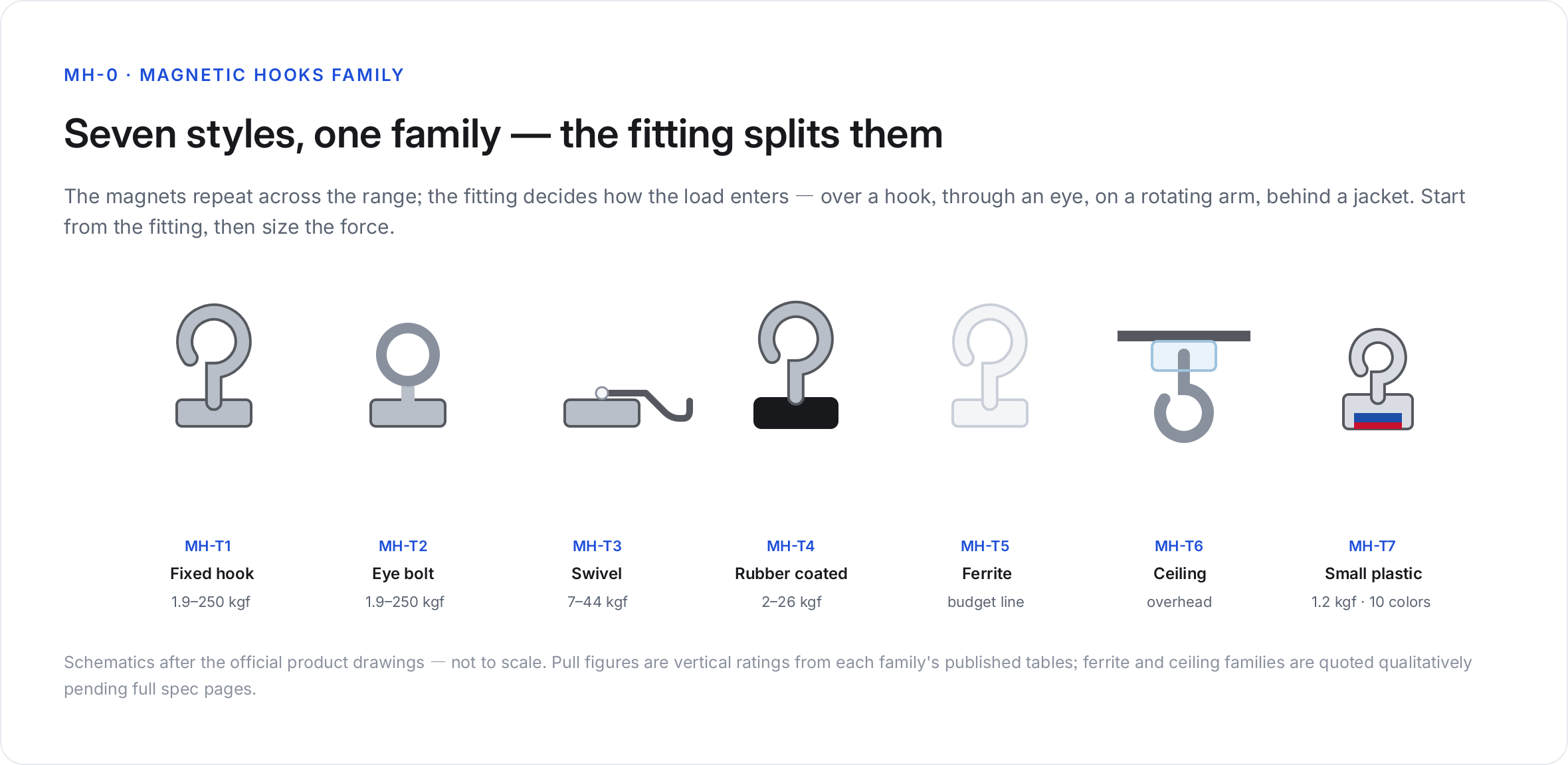
Every hook in this family is the same three-part idea, scaled up or down:
That third part is the real split between the seven styles. The magnets repeat; the fittings differ — and the fitting is what your application should choose. (The same cups without any fitting live in the pot magnet range.)
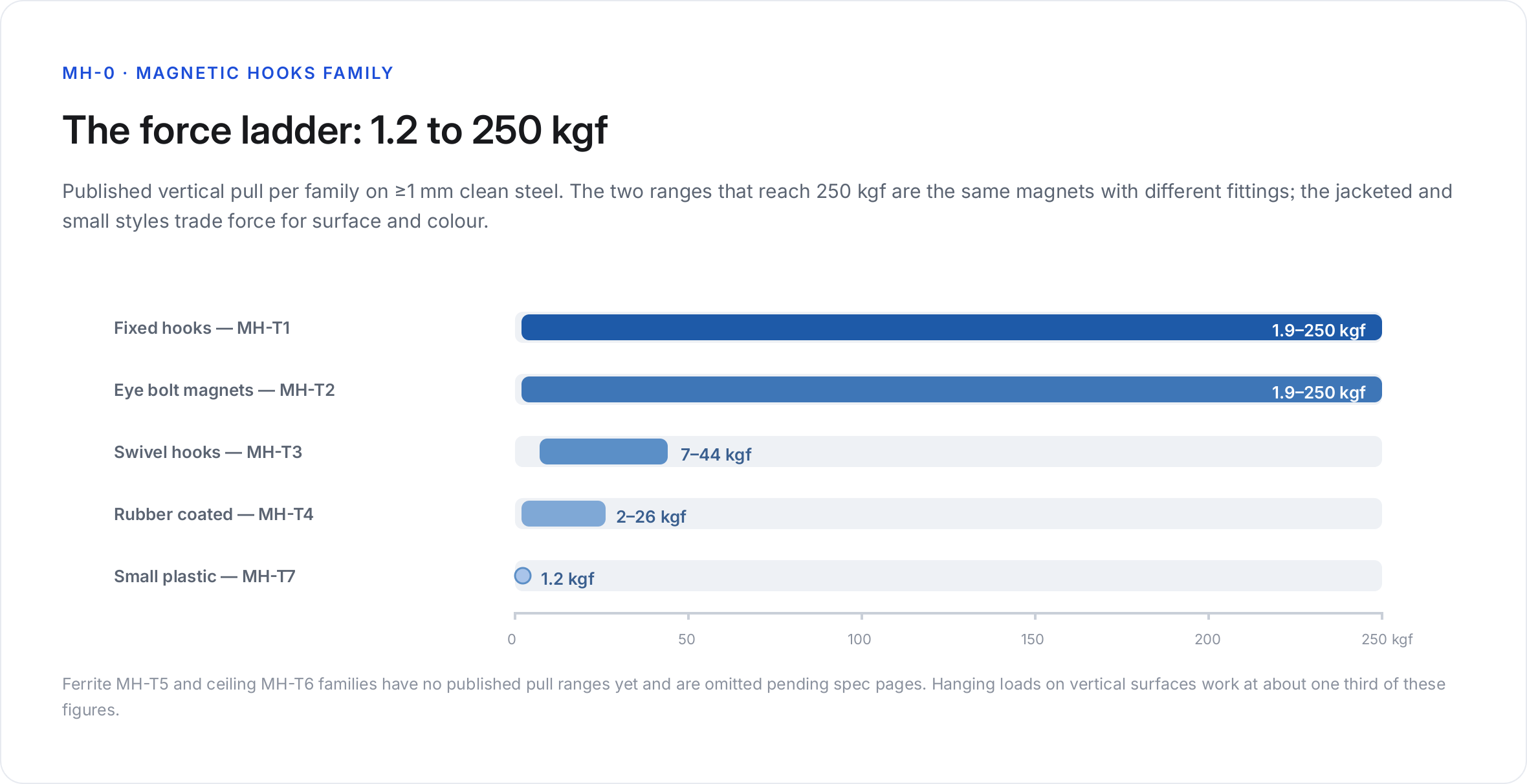
The range covers a force span of 200:1, so the same product line serves very different jobs:
| Style | Code | Sizes | Pull range | Fitting | Jacket | Best for |
|---|---|---|---|---|---|---|
| Fixed hooks | MH-T1 | 11 (Ø10–75 mm) | 1.9–250 kgf | J hook, M3–M10 | plated steel | max force per dollar |
| Eye bolt magnets | MH-T2 | 11 (Ø10–75 mm) | 1.9–250 kgf | closed eye, M3–M10 | plated steel | rope, chain, carabiner |
| Swivel hooks | MH-T3 | 6 (Ø16–42 mm) | 7–44 kgf | riveted rotating arm | plated steel | loads that rotate |
| Rubber coated | MH-T4 | 13 (Ø22–88 mm) | 2–26 kgf | J / ring / wire loop | rubber | delicate surfaces |
| Ferrite hooks | MH-T5 | several | budget range | J hook | ferrite body | cost-driven, wet areas |
| Ceiling hooks | MH-T6 | several | varies | hook under plate | plated steel | overhead suspension |
| Small plastic | MH-T7 | 1 (Ø12 mm), 10 colors | 1.2 kgf | moulded in | ABS plastic | light loads, colour systems |
One row worth reading twice: MH-T1 and MH-T2 share the same magnets, which is why both are rated as full neodymium magnetic hooks rather than light-duty variants. The difference is only the fitting — a hook you hook things onto, versus an eye you thread things through. If your load is a rope or a carabiner, the closed loop of MH-T2 is the safer interface even though the pull numbers are identical.
Across the neodymium magnetic hooks range, the published pull spans two hundred-fold. What actually sets each rung:
Design guidance for every neodymium magnetic hooks purchase: take the catalogue pull, apply the one-third rule for hanging loads, apply surface deductions, and keep a 3–5× safety factor on anything that could drop onto a person. The sub-pages carry the exact tables.
Five rules hold across all seven styles of neodymium magnetic hooks; learn them once here:
The classic: steel cup, threaded boss, screwed-in J hook. Eleven stock sizes from Ø10 to Ø75 mm, 1.9 to 250 kgf, M3 to M10 threads. The fixed hook is the cheapest force in the neodymium magnetic hooks range and the right answer whenever the load hangs still and the hook does not need to rotate or come off. Its subtlety is the thread: the published pull is the magnet's, but the working load is limited by the hook's thread as a fuse — full explanation and all eleven spec rows on the MH-T1 page.
These neodymium magnetic hooks share their magnets with MH-T1, but the fitting is a closed eye: rope, cable, chain or a carabiner threads through and cannot slip off. Two things change with the eye: the load must enter in the eye's plane (cross-plane loading can peel the assembly off), and the tall eye adds a lever arm that fights the magnet. The MH-T2 page carries the eye-plane loading rules and the height-moment calculation.
The hook pivots on a rivet at the cup's centre, and gravity swings the load plumb whatever angle the surface sits at — the magnet underneath keeps working straight through its strongest axis. Swivels are the neodymium magnetic hooks of choice where the surface angle changes or the load twists. Six sizes, Ø16–42 mm, 7–44 kgf, total profile just 11–15.5 mm. The pivot is riveted, not threaded — the fitting cannot be swapped, which is the price of the rotation. Selection rules and the efficiency table live on the MH-T3 page.
A rubber jacket over the steel pot buys these neodymium magnetic hooks three things a bare cup cannot give: a scratch-free contact face, real friction against sliding, and a quiet, corrosion-resistant shell for washdown areas. Three fittings on the same jacketed pot — J hook, ring, swivel wire loop — in thirteen sizes, Ø22–88 mm, 2–26 kgf. The MH-T4 page compares all three fittings and flags the two spec-table rows that need a second look.
Where the pull numbers above are more than the job needs, ferrite (ceramic) magnets cut the cost per unit sharply. Ferrite is weaker than neodymium per volume — expect a fraction of the pull at the same size — but it brings two real advantages: it needs no plating against corrosion, and it tolerates far higher temperatures than standard neodymium grades. That combination makes the ferrite line the pick for wet areas, wash-down zones and cost-driven volume projects. The range lives on the ferrite magnetic hooks category page.
General-purpose hooks should not go overhead — a failed hook at head height is a nuisance, overhead it is a liability. The ceiling-hook family exists precisely for that job: the fitting is oriented for direct tension, the strongest direction a magnet has, where the full rating is available instead of the one-third shear figure. Even so, overhead work demands a deliberate factor of safety — we recommend 5× on suspended loads, and permanent fixtures should be engineered, not guessed. The ceiling styles are on the ceiling hooks category page.
One moulded ABS shell with the hook formed as part of it, a neodymium disc inside, ten pigment colours, 1.2 kgf, 2.6 grams, thirty cents. Nothing screws in, nothing rusts, nothing sticks out beyond 18 mm — the smallest of our neodymium magnetic hooks, and the only one jacketed in colour. It is the organisational tool of the family — colour-code a classroom, a kitchen, a cruise cabin — more than a force tool. Full anatomy and the honest pull numbers on the MH-T7 page.
Two answers end the search early: if the load exceeds 26 kgf, the answer is MH-T1 or MH-T2 — the only styles that reach 250 kgf. If the load is under 300 g and colours help, MH-T7 ends it at the other end. Everything in between is a choice among the mid-force neodymium magnetic hooks — swivel, rubber coated or ferrite.
The seven styles are the standard line; a large share of our production is custom. Typical requests: a special hook geometry or opening, a higher load capacity in a tighter envelope, a different thread or fitting interface, brand-coloured plastic shells, rubber compounds matched to a chemical environment, and complete neodymium magnetic hooks assemblies engineered around the customer's steel structure. Bring the load case, the surface and the annual quantity, and our engineering team assists from product design and optimisation through prototyping to mass production — the same team that publishes the pull tables on the sub-pages.
What is a magnetic hook? A magnetic assembly that combines a neodymium magnet working through a steel cup with a hook fitting — hang, organise and secure items on steel surfaces with no permanent installation. All seven styles below are neodymium magnetic hooks except the ferrite budget line.
How much weight can a magnetic hook hold? Between 1.2 kgf and 250 kgf across the neodymium magnetic hooks range. The catalogue number is a vertical pull on thick clean steel; a hanging load on a wall works in shear at roughly one third of that. Paint and thin sheet reduce it further.
What is the difference between a magnetic hook and a standard hook? A standard hook needs screws, nails or adhesive; a magnetic hook attaches and repositions instantly on ferromagnetic surfaces, leaving no marks — ideal for temporary and flexible installations.
What are swivel magnetic hooks? Hooks whose fitting pivots on a rivet at the cup's centre: gravity keeps the load plumb at any surface angle. See the MH-T3 family — 6 sizes, 7–44 kgf.
Can magnetic hooks be used on ceilings? Purpose-built ceiling styles (MH-T6) are oriented for direct tension, where the full rating applies. General-purpose hooks should not go overhead; permanent suspended fixtures need an engineered safety factor of 5×.
Are magnetic hooks suitable for outdoor use? Yes, with the right jacket: rubber coated for durability, ferrite where corrosion and cost dominate. Wet steel is weaker steel, so derate the published pull outdoors.
What materials do magnetic hooks attach to? Steel and iron only. Not aluminium, copper, brass, wood, plastic — and many stainless grades (304/316) will not hold. Test stainless before specifying.
Can magnetic hooks damage surfaces? Bare plated cups can scratch glossy paint if slid. Rubber coated (MH-T4) and plastic (MH-T7) styles are the scratch-free choices.
Can magnetic hooks be customized? Yes — hook geometry, magnet material, coating, load capacity, thread interface and complete assemblies. Start at the custom magnets page.
Are magnetic hooks suitable for industrial applications? That is the core of the neodymium magnetic hooks range: manufacturing facilities, warehouses, maintenance workshops and automation lines use the 20–250 kgf styles for tools, cables, hoses and fixtures.
What is the maximum operating temperature? Standard neodymium: 80 °C. Ferrite: far higher. High-temperature neodymium grades are available through the custom route.
How do I choose the right magnetic hook? Work the five questions above: load interface, surface, pull direction, environment, budget. Send the load case to our engineers if it sits between two styles — the answer is usually a fitting choice, not a bigger magnet.
Every style above ships from our own production line — the reason these neodymium magnetic hooks hold their prices and the custom route starts from the same magnets. Contact us with a load case, a drawing or just the object you need to hang — engineering answers the same day.