A plastic magnetic hook is the smallest, lightest hook in our magnetic hooks range: a neodymium disc fully sealed inside a moulded plastic shell, with the hook formed as part of that same shell — nothing screws in, nothing can rust, and nothing sticks out beyond the 18 mm total height. It holds 1.2 kgf on thick clean steel, weighs 2.6 grams, costs $0.30, and comes in ten colours.
That sounds modest next to the 250 kgf monsters elsewhere on this site, and that is the point. Most hanging jobs in a kitchen, office, classroom, cruise cabin or retail backroom are under half a kilogram. For those jobs plastic magnetic hooks are the right tool: cheap enough to deploy by the dozen, colourful enough to double as an organisational system, and sealed well enough for steamy bathrooms.
This page covers our MH-T7 plastic magnetic hooks in full: the one stock size (Ø12 mm base, 6 mm shell thickness, 18 mm overall height), the real pull numbers behind the catalogue, the air-gap penalty the shell charges you, the one-third rule for sideways loads, and the ten colourways you can order today.
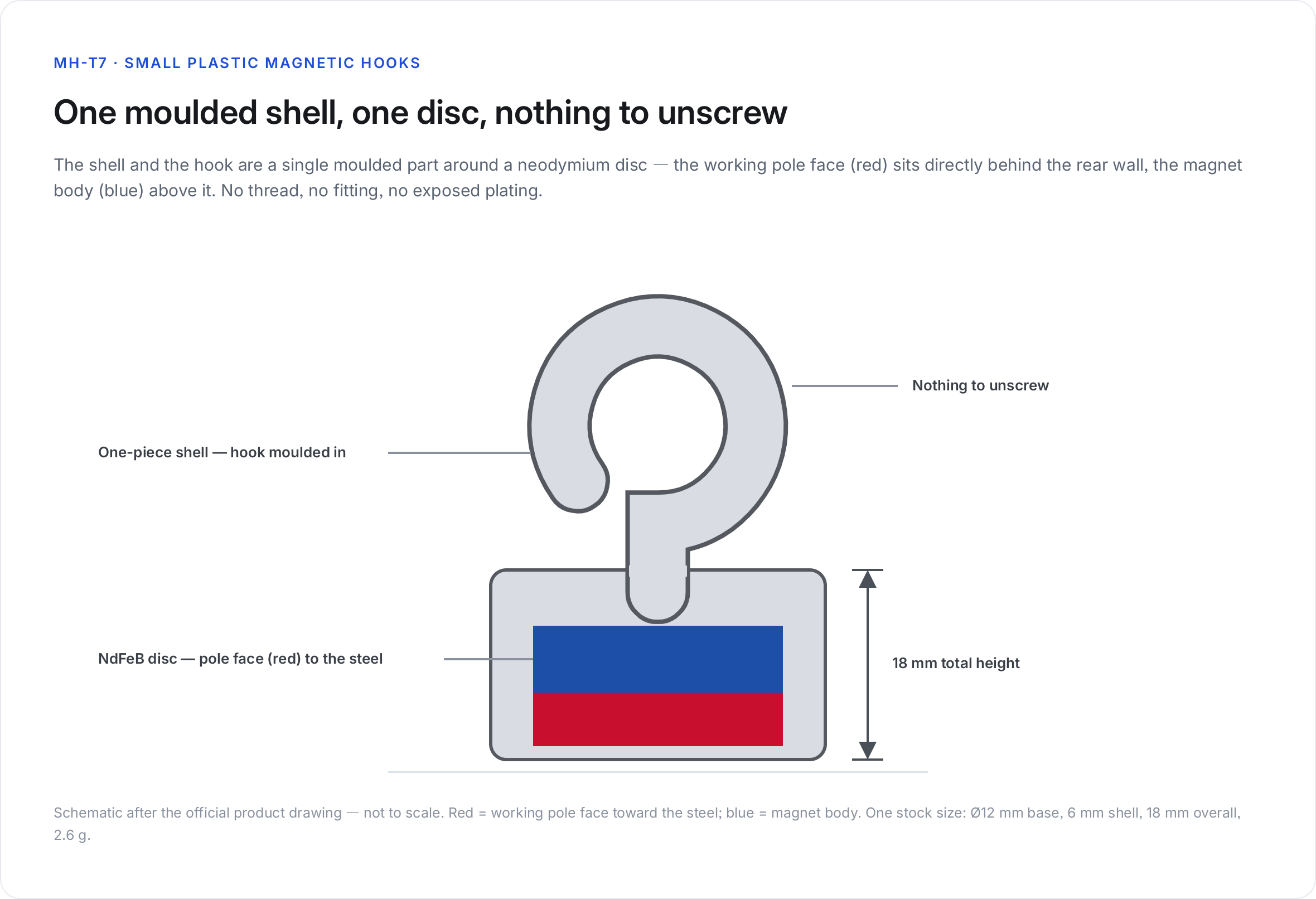
Inside every one of these plastic magnetic hooks is a neodymium disc magnet — the same neodymium magnet material used across our whole hook range, oriented with its working pole facing the back face of the shell. Around it, the plastic shell is moulded in one piece: base, walls and hook are a single part. The user-facing consequence is simple:
The shell material is an ABS-class engineering polymer — rigid, impact-resistant, and available in stable pigmented colours (see acrylonitrile butadiene styrene for the material family). Colour is pigment mixed into the same polymer, so a red unit and a white unit are mechanically identical.
Plastic magnetic hooks in the MH-T7 range are deliberately a single size. One geometry, ten pigment options, one price:
| Property | Value |
|---|---|
| Base diameter | 0.472 in / 12.0 mm |
| Base thickness (shell) | 0.236 in / 6.0 mm |
| Overall height, incl. hook | 0.709 in / 18.0 mm |
| Weight | 0.091 oz / 2.6 g |
| Magnet | Neodymium (NdFeB) disc, pole face to rear |
| Pull force (vertical, thick steel) | 2.65 lb / 1.2 kgf |
| Shell material | ABS-class polymer, pigmented |
| Colors | Black, white, orange, pink, red, yellow, blue, green, purple, cyan |
| Unit price | $0.30 |
Read the three dimensions as one sentence: the magnet face is 12 mm across, the shell walls are 6 mm thick front to back, and the whole assembly — hook included — stands 18 mm off the surface. On a fridge door or a steel cabinet side, it disappears visually; that is the "space-saving" claim from our product copy, and it is measurable: 18 mm is less than the diameter of most towel rails.
At 2.6 grams these plastic magnetic hooks are the lightest in our range — a tenth of the smallest bare-steel MH-T1 unit. Efficiency per gram is 0.46 kgf/g, which sits mid-pack in the range: swivel hooks reach 0.66 kgf/g at Ø20 mm, but no other hook ships at thirty cents.
Magnet pull does not fall off gently with distance — it collapses. Every fraction of a millimetre of non-magnetic material between the pole face and the steel costs a disproportionate share of the force, and plastic magnetic hooks carry a shell that a bare steel cup does not:
Some of that difference is the 2 mm of extra diameter working in the bare hook's favour — but most of it is the gap. The steel cup in MH-T1 short-circuits the magnetic path right down to the surface; the plastic shell inserts a permanent spacer. This is the same physics that makes a refrigerator magnet weak through a calendar and strong directly on the door.
Design every plastic magnetic hooks project around the number the catalogue publishes — 1.2 kgf — and treat anything above it as margin you do not have. If your application needs the seal and the colour but more force, the honest comparison is our rubber coated magnetic hooks, which start at 2 kgf in Ø22 mm because their steel pot sits behind a thinner jacket.
Plastic magnetic hooks hang loads in shear, not pull. A hook loaded sideways — the normal case for anything hanging under gravity on a vertical surface — works at roughly one third of the vertical rating, because the load is trying to slide the magnet down the steel while peeling one edge off:
| Loading | Effective limit on thick clean steel |
|---|---|
| Vertical face, hanging load (shear) | ≈ 0.4 kgf / 0.9 lb |
| Vertical pull-off, perpendicular | 1.2 kgf / 2.65 lb |
| Overhead, ceiling-mounted (pure tension + risk) | not recommended without a large safety factor |
In practice: one of these plastic magnetic hooks hangs four house keys (≈60 g) with margin; it holds a dish towel; it will not hold a cast-iron pan. Two hooks sharing a load roughly double the shear capacity, and spacing them vertically (not horizontally) keeps both working in their strongest direction.
Our marketing copy for this product quotes 8 lb vertical and 2.5 lb horizontal. Those figures and the catalogue's 2.65 lb have not yet been reconciled by engineering — see the next section before you design to either.
Two pull numbers for plastic magnetic hooks are published on this page today:
| Source | Figure | Meaning |
|---|---|---|
| Product catalogue (all ten SKUs) | 2.65 lb / 1.2 kgf | The rated pull force per unit |
| Marketing copy (this page's intro) | 8 lb vertical, 2.5 lb horizontal | Unverified against the catalogue |
Until engineering signs off on the 8 lb figure, treat 1.2 kgf vertical and ≈0.4 kgf in shear as the design numbers. The likely explanation is that 8 lb refers to the bare magnet's direct pull-off before the shell's air gap — a number a user can never realise through the hook. We would rather publish the conservative number and keep it than publish the flattering one and replace your fixtures. If you need the larger figure confirmed or characterised on your specific steel, contact us and we will run the test.
The notes on our product pages say it correctly: the thicker the steel, the stronger the hold. The magnet's field must saturate the steel behind it; thin sheet simply runs out of iron. What that means per surface:
| Surface | What to expect from 1.2 kgf |
|---|---|
| Fridge door, steel cabinet, whiteboard backing (≥1 mm steel) | Full rating, 1.2 kgf vertical / ≈0.4 kgf shear |
| Thin sheet steel (≤0.6 mm) | Expect roughly half or less; test before trusting |
| Painted or enamelled steel | Paint is another air gap — deduct 20–50% |
| Stainless (austenitic 304/316) | May not hold at all — non-magnetic grades |
| Wood, drywall, tile | Zero — there is no ferrous surface |
That last row is worth emphasising because it is the most common returns reason for plastic magnetic hooks: they stick to iron and steel only. On a painted steel door it still works, but the paint layer eats into the already thin margin. On brick, plaster or glass there is nothing to grip — that is a job for adhesive or drilling, not for any magnetic hook, whatever it is jacketed with.
The colours on plastic magnetic hooks are not decoration; used deliberately, they are a zero-writing labelling system. A colour code needs no literacy, survives distance, and never falls off the way a sticky label does:
Because plastic magnetic hooks are one moulded piece with the colour in the polymer — not paint on a surface — the colour does not chip off with use. Units that get knocked around a tool room stay their colour for their service life.
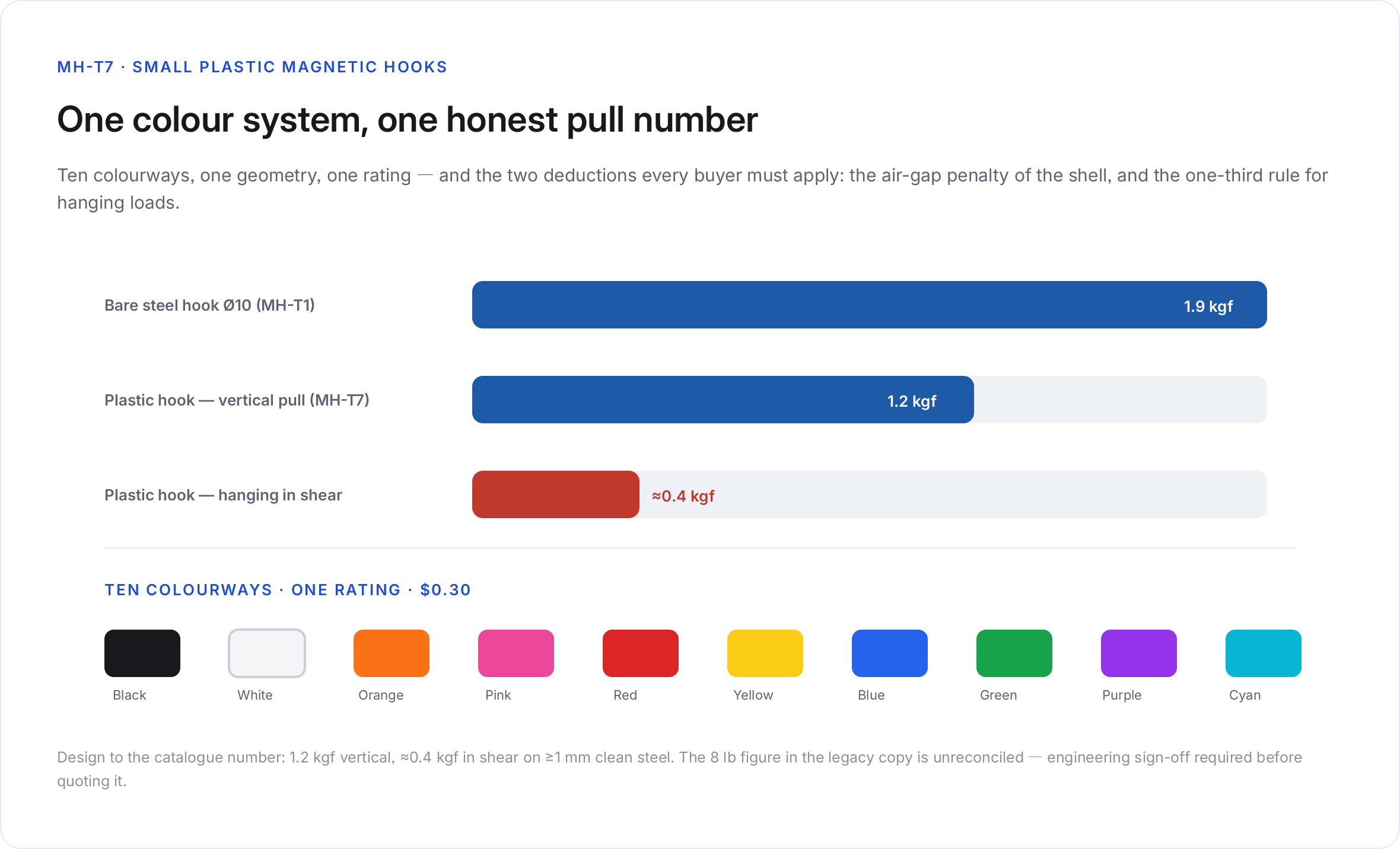
Every colour in the plastic magnetic hooks catalogue is the same geometry, the same magnet, the same 1.2 kgf rating, the same $0.30. Pick by system, not by spec:
| Color | Product page | Color | Product page |
|---|---|---|---|
| White | d0-472x0-709 | Red | d0-472x0-709-5 |
| Black | d0-472x0-709-2 | Yellow | d0-472x0-709-6 |
| Orange | d0-472x0-709-3 | Blue | d0-472x0-709-7 |
| Pink | d0-472x0-709-4 | Green | d0-472x0-709-8 |
| Purple | d0-472x0-709-9 | Cyan | d0-472x0-709-10 |
Mixed-colour cartons of plastic magnetic hooks are fine for sampling; production orders usually take one colour per carton so the organisational system stays clean. For quantities beyond carton volume, jump to the custom route below.
The load cases plastic magnetic hooks were built for, straight from how customers actually use them:
The pattern across all of these: loads under ~300 g, indoors, on bare or lightly painted steel, where appearance matters and volume matters. At $0.30, deploying twenty plastic magnetic hooks costs less than one decent steel hook — and colour does the organising.
Three red lines for plastic magnetic hooks, each learned from real returns:
One more: textured or soft plastics. On a rubberised fridge gasket or a coated shelf, the shell cannot seat flush and the pull collapses. Flat steel only.
Plastic magnetic hooks share their family tree with two other jacketed hooks in the range. The differences are all in the jacket and what it costs you:
| MH-T7 plastic | MH-T4 rubber coated | MH-T1 bare steel | |
|---|---|---|---|
| Sizes | 1 (Ø12 mm) | 13 (Ø22–88 mm) | 11 (Ø10–75 mm) |
| Pull range | 1.2 kgf | 2–26 kgf | 1.9–250 kgf |
| Jacket | ABS polymer, integral hook | EPDM-type rubber over steel pot | none, plated steel |
| Fitting | moulded in, not replaceable | screwed in, replaceable | screwed in, replaceable |
| Surface protection | scratch-free, wipeable | scratch-free, anti-slip | can scratch glossy surfaces |
| Color options | 10 | black | none |
| Best for | light loads, colour systems | heavy loads on delicate surfaces | max force per dollar |
The structural comparison with the rest of the family — eyebolt magnets for shackles, swivel hooks for rotating loads — lives on the magnetic hooks category page. The short version: if the load hangs still and light, plastic magnetic hooks win on price, colour and silence; the moment force or replaceability matters, the screwed-fitting families take over. Even the pot magnet range without any hook starts higher than 1.2 kgf.
Our product pages carry a "more notes" block. Here is what each one means in practice for plastic magnetic hooks:
The ten catalogue colours cover most plastic magnetic hooks systems, but brand colours are a common request — a retailer wanting hooks in its own Pantone, a factory colour-matching its tool-shadow boards, a cruise line matching cabin decor. Because plastic magnetic hooks take colour as pigment in the shell polymer, a custom shade is a tooling and MOQ conversation, not a repainting job: bring the target colour, the annual quantity and the load case, and contact us for a moulding quote. Geometry changes (a larger base, a different hook opening, a logo boss on the front) go through the same custom magnets route as every other MH-T family part.
How much weight can a plastic magnetic hook hold? 1.2 kgf vertical pull on thick clean steel. On a vertical wall the hanging load works in shear at roughly a third — about 400 g per hook — and paint or thin sheet steel reduces that further.
Why is it weaker than a bare metal hook of the same size? The plastic shell sits between the magnet and the steel and acts as a permanent air gap; pull force collapses with distance. A bare Ø10 mm steel hook already pulls 1.9 kgf.
Do the different colours pull differently? No. Colour is pigment in the same ABS shell; plastic magnetic hooks all share one geometry, one magnet and one rating of 1.2 kgf.
What is the shell made of? An ABS-class engineering polymer moulded in one piece — base, walls and hook. The material family is rigid, impact-resistant and colour-stable; full material data sheets are available on request.
Will it rust or stain a surface? The magnet never contacts air or water, and there is no plating to scratch through. It is the hook we recommend for steamy kitchens, bathrooms and galleys.
Does it work on a painted wall or a wooden door? No. It needs ferrous steel. Painted steel works with a deduction for the paint layer; wood, drywall, glass and austenitic stainless do not work at all.
Is it safe near pacemakers or credit cards? Keep 30 cm from implanted pacemakers and defibrillators, and store units away from magnetic-strip cards. The same caution applies to every magnet we ship.
What is the maximum temperature? 80 °C sustained — set by the ABS shell, not the magnet. Above that the shell softens gradually.
Can I order a custom colour? Yes. Custom shades are pigment changes in the shell polymer with an MOQ; see the custom section above or contact us with your Pantone reference and annual volume.
Why does my hook slide down the fridge door? It is loaded in shear on a smooth, possibly enamelled surface — the weakest realistic case. Use two hooks spaced vertically, keep the load under 400 g total, or move the load to a horizontal face.
Plastic magnetic hooks ship from our factory floor, which is why ten colours can sit at $0.30. Whether you need one carton of cyan for a classroom or a colour-matched moulding run for a retail chain, start at the plastic magnetic hooks category page or contact us directly — engineering answers pull-force and material questions the same day.