Neodymium block magnets are rectangular NdFeB magnets with flat faces on all six sides, specified by length × width × thickness. The flat geometry puts a large, uniform pole face against the workpiece, which is why blocks dominate fixturing, mounting and assembly work where a round magnet would only touch on a line.
NEOMAG stocks neodymium block magnets from 4 mm to 15 mm in length and ships selected standard sizes from our U.S. warehouse in Redlands, California. Standard products are magnetized through the thickness and Ni-Cu-Ni plated; other magnetization directions, coatings and non-standard dimensions are available as custom block magnets.
A block magnet is a rectangular magnet where length and width are both greater than the thickness. In the magnet trade the dividing lines are:
At NEOMAG, neodymium block magnets, squares, plates and cubes are grouped into a single Block Series, so you can compare them in one place instead of guessing which category a part belongs to.
Blocks are made from sintered NdFeB, the strongest permanent magnet material commercially available. Because the alloy is roughly two-thirds iron and prone to corrosion, every neodymium block magnet is supplied with a protective coating.
Our Block Series covers small cubes through 15 mm plates. Typical published specifications:
| Parameter | Standard stock | Custom capability |
|---|---|---|
| Length | 4 mm – 15 mm (0.157" – 0.591") | Outside this range on request |
| Width | 3 mm – 10 mm (0.118" – 0.394") | Outside this range on request |
| Thickness | 1 mm – 10 mm (0.039" – 0.394") | Outside this range on request |
| Dimensional tolerance | ±0.3 mm to ±2.0 mm, scaling with part size | Tighter tolerances on request |
| Grade | N35 – N52 | Grade selected to the application |
| Max operating temperature | 80 °C (176 °F) standard | Up to 200 °C with high-coercivity grades |
| Coating | Ni-Cu-Ni (nickel-copper-nickel) | Epoxy, zinc, gold, parylene, rubber overmould |
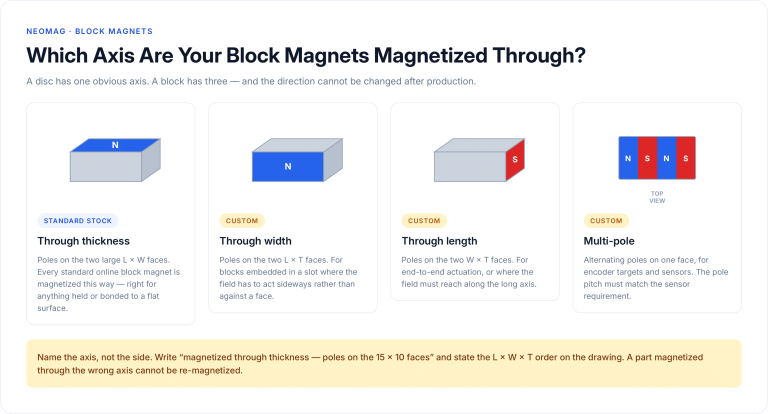
| Magnetization | Through thickness | Through length, through width, multi-pole |
| Stock | Selected sizes held in Redlands, CA | Made-to-order |
Always confirm availability for the exact neodymium block magnets and quantities you need before you commit to a production schedule.
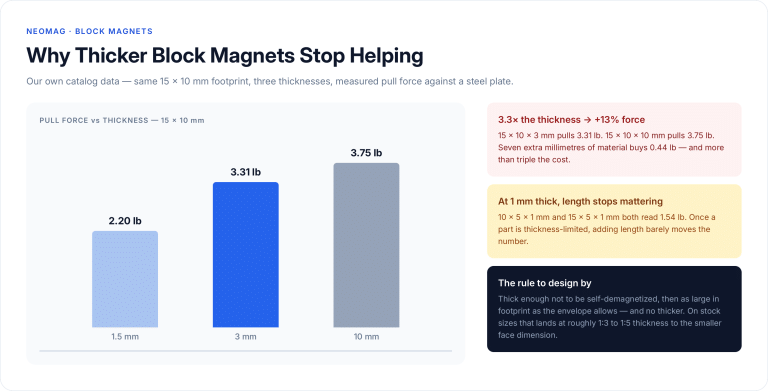
Three dimensions means three ways to gain force — and they do not contribute equally. Our own catalog data shows the pattern clearly.
Take the 15 × 10 mm footprint in three thicknesses:
| Size (L × W × T) | Weight | Pull force | Surface gauss |
|---|---|---|---|
| 15 × 10 × 1.5 mm | 1.4 g | 2.20 lb (1.00 kgf) | ~1,900 Gs |
| 15 × 10 × 3 mm | 3.0 g | 3.31 lb (1.50 kgf) | ~2,400 Gs |
| 15 × 10 × 10 mm | 9.3 g | 3.75 lb (1.70 kgf) | ~2,600 Gs |
Going from 1.5 mm to 3 mm doubles the material and buys +50% holding force. Going from 3 mm to 10 mm multiplies the material by 3.3 and buys +13%. That is the whole argument for keeping blocks thin.
The reason is the demagnetizing field. A magnet works against its own internal field, and the thinner the part relative to its pole face, the harder the material is pushed. Adding thickness improves the working point — but only up to the point where the magnet is no longer being self-demagnetized. Past that, extra material is largely dead weight.
Length behaves even less intuitively. Two neodymium block magnets with the same 1 mm thickness read the same pull force whether they are 10 mm or 15 mm long:
| Size (L × W × T) | Weight | Pull force |
|---|---|---|
| 10 × 5 × 1 mm | 0.2 g | 1.54 lb |
| 15 × 5 × 1 mm | 0.4 g | 1.54 lb |
A 50% longer magnet gave no measurable gain, because at 1 mm the part is already thickness-limited. The practical rule: a block should be thick enough not to be self-demagnetized, then as large in footprint as the envelope allows — and no thicker. For most stock sizes that lands somewhere around 1:3 to 1:5 thickness to the smaller face dimension.
Two more things worth knowing about catalog pull force figures:
Always test neodymium block magnets in the actual assembly before committing to volume. The magnetic circuit around the part matters as much as the part itself.
The grade number broadly indicates the maximum energy product: a higher number means more magnetic energy from the same volume. But grade alone says nothing about heat — that is what the temperature suffix is for.
| Grade family | Max operating temperature |
|---|---|
| N (N35 – N52) | 80 °C / 176 °F |
| M | 100 °C / 212 °F |
| H | 120 °C / 248 °F |
| SH | 150 °C / 302 °F |
| UH | 180 °C / 356 °F |
| EH | 200 °C / 392 °F |
Standard stock neodymium block magnets are N-grade with an 80 °C limit. Thin blocks are the most vulnerable: a 1 mm plate has a poor working point already, so it will lose magnetism at a lower temperature than a thick cube of the same grade.
If your assembly runs warm, the temperature suffix matters more than the grade number. See Curie temperature vs operating temperature for why the two are different.
For energy product reference: N35 falls in the 263–287 kJ/m³ range, N42 in 318–342 kJ/m³, and N52 in 398–422 kJ/m³. Our neodymium magnet grades guide and the N35 vs N42 vs N52 comparison go deeper.
This is where blocks differ most from discs. A disc has one obvious axis; a block has three, and the wrong one cannot be corrected after production. Confirm the direction in writing before you order. See orientation and magnetization of NdFeB magnets for the underlying principle.
Two habits that prevent most block-magnet mistakes:
Name the axis, not the "side". "Poles on the top and bottom" is ambiguous in a 3D part. Write "magnetized through thickness — poles on the 15 × 10 faces".
State the dimension order. L × W × T is a convention, not a law. If your drawing says 15 × 10 × 3, confirm which of the three is the small one, because that is the axis a standard part is magnetized through.
Neodymium block magnets are supplied plated because bare NdFeB corrodes quickly in humid air. Standard stock is Ni-Cu-Ni — a triple-layer nickel-copper-nickel deposit that gives a bright silver finish and good protection in dry, indoor environments.
Where the environment is humid, wet or chemical-exposed, or where the part sees impact, a different finish is usually the better call: epoxy, nickel-plus-epoxy duplex, parylene, gold over nickel, or a rubber overmould.
Coating eats tolerance in two directions on a block — every dimension grows by roughly twice the coating thickness, and plate edges can build up slightly thicker than the faces. On a 1 mm plate that matters: state whether your dimensions are before or after coating. Our neodymium magnet coatings guide compares thickness, salt spray performance and temperature limits, and how to select a coating for NdFeB magnets walks through the decision.
| Block magnet | Cube magnet | Disc magnet | Pot magnet | |
|---|---|---|---|---|
| Shape | L and W > T | All sides equal | D > T, round | Magnet inside a steel cup |
| Pole face | Large, flat, directional | Large, flat | Round, flat | Concentrated in the cup face |
| Holding force | High per size | High per size | High, area-driven | Highest for a given size; shielded on the back |
| Best for | Fixtures, embedding, bonding, slots | Compact holding, prototyping | Round mounts, sensors, speaker drivers | Through-panel mounting, hanging, jigs |
| Downside | Directional — must be oriented correctly | Small range of sizes | Round contact needs a drilled seat | Bulkier, more expensive |
Block versus disc is usually decided by the mounting feature, not by force: a block sits in a milled pocket without rotating, which a disc will do. Blocks resist torque; discs resist nothing. That single fact decides a lot of designs. For the full geometry comparison see neodymium magnet shapes, or jump to our disc magnets, ring magnets, countersunk magnets and pot magnets pages.
Neodymium block magnets appear in nearly every industry, from production lines to consumer devices.
Fixtures and workholding — magnetic clamps, jigs, welding and assembly fixtures. The flat face gives full contact on machined steel and the rectangular body keys into a pocket without rotating.
Automation and robotics — end-of-arm grippers, part presenters and magnetic transfer stations, where a block can be embedded flush in an aluminium plate.
Motors and generators — linear actuators, sensor magnets and small motors where a flat, uniform field is required across a defined gap.
Sensors and switches — reed switches, Hall effect sensors and position sensing. Blocks are often chosen because the field is predictable over a defined face rather than a circle.
Magnetic separation — capturing ferrous contamination in processing lines and chutes.
Loudspeakers and audio — magnet assemblies where the flat face delivers a uniform field across the voice coil gap.
Consumer closures and hardware — cabinet latches, door catches, packaging closures, tool holders. For distributors, stocked sizes and bulk packaging are usually the deciding factors.
R&D and prototyping — test rigs and breadboards, where quick access to a range of stocked sizes shortens iteration.
More detail in 15 key industrial NdFeB magnet applications.
Send these nine items and you will get a quote back faster, with fewer clarification rounds:
1. Dimensions — length × width × thickness, with tolerance
2. Which dimension is which — confirm the axis order on your drawing
3. Dimensions before or after coating — state which
4. Magnetization direction — through thickness, width or length
5. Grade — if known; otherwise describe the required performance
6. Maximum operating temperature — continuous and peak
7. Coating — and any corrosion test requirement
8. Quantity — including anticipated annual volume
9. Application — mating material, mounting method, drawings or photos
Our guide to specifying custom neodymium magnets covers the eight core decisions in detail, and how to describe a magnet procurement requirement explains what your drawing should show.
U.S. stock and fast fulfillment. Selected in-stock neodymium block magnets ship from our warehouse in Redlands, California, giving U.S. customers shorter lead times and simpler logistics.
Bulk supply for distributors and OEMs. We support volume buyers with repeatable inventory and scheduled supply rather than one-off shipments. If you are weighing stocked sizes against made-to-order, see standard vs custom neodymium magnets.
Inspection before shipment. Every order is checked for dimensions, magnetic performance, coating quality and batch consistency, with batch traceability retained.
Custom manufacturing. Non-standard dimensions, tighter tolerances, through-width and through-length magnetization, alternative coatings and complete magnetic assemblies.
Custom packaging. Packaging specified for safe handling, protection in transit and retail-ready presentation.
Twenty years in NdFeB. Technical support on grade, geometry and magnetization direction before you commit to tooling. About NEOMAG.
Standard Block Series sizes run from roughly 4 mm to 15 mm in length, 3 mm to 10 mm in width and 1 mm to 10 mm in thickness. Availability varies by size and quantity, so confirm current stock for the exact part you need.
All standard stock neodymium block magnets are magnetized through the thickness — poles on the two large L × W faces. Through-length, through-width and multi-pole magnetization are custom options.
Not per unit volume — both are NdFeB and follow the same physics. A block holds more than a disc of the same overall size only because a rectangle fills an envelope more completely than a circle. The real reason to choose a block is mechanical: it will not rotate in a pocket, and it offers a flat face for bonding.
Footprint first. In our 15 × 10 mm family, going from 3 mm to 10 mm thickness — 3.3 times the material — adds only 13% holding force, while doubling the footprint from 10 × 5 mm to 15 × 10 mm roughly doubles it. Thickness only needs to be enough that the magnet is not self-demagnetized.
Because a magnet works against its own demagnetizing field. Extra thickness improves the working point up to a limit; beyond that the added material contributes little to the external field. See our note on shape anisotropy and demagnetizing factor.
No. Sintered NdFeB is hard and brittle; cutting or drilling can fracture the part, and the heat and mechanical shock can demagnetize it. Machining also removes the coating and exposes the material to corrosion. Order the size you need instead — see common processing methods for neodymium magnets.
N35 to N52 covers most requirements. Choose the grade from the magnetic output you need within the available space, then check the temperature suffix against your real operating temperature. In warm assemblies the suffix matters more than the grade number — see N35 vs N42 vs N52.
Ni-Cu-Ni is the standard stock finish and suits dry indoor environments. For humid, wet, chemical-exposed or high-impact service, consider epoxy, nickel-plus-epoxy duplex, parylene or a rubber overmould. Our coating selection guide compares thickness, corrosion resistance and temperature limits.
Yes. We work with distributors, OEMs and industrial buyers on standard products, bulk supply and custom manufacturing. Send the specification, estimated quantity and purchasing requirements for review.
Avoid impacts — thin plates chip at the edges. Keep magnets away from electronic devices and magnetically sensitive media, watch for pinch hazards, and store blocks with separators so they do not slam together.
Whether you need stocked standard sizes shipped this week or a custom geometry built to drawing, NEOMAG can supply it. Browse the Block Series and filter by size, or request a quote with your dimensions, magnetization direction, grade, coating and quantity.