Neodymium sphere magnets are the shape that moves. Every other magnet in the neodymium family is designed to stay put — discs hold faces, blocks fill pockets, rings ride shafts. A sphere rotates, self-aligns, snaps into chains and rolls across a steel sheet, which is exactly why engineers, teachers and designers reach for it.
This page covers the full specification set for neodymium sphere magnets: the 5 mm series and its pack sizes, diametrical magnetization, the honest answer about holding force, coatings, grades — and the safety rules that matter more for spheres than for any other shape.
A neodymium sphere magnet is a ball-shaped sintered NdFeB magnet measured by a single dimension: diameter. That symmetry is its defining feature — there is no "front", no mounting face, no wrong orientation, because the magnet can rotate freely until its magnetic axis lines up with whatever field surrounds it.
Practical consequences of perfect roundness:
Our sphere series is built around a 5 mm diameter — small enough for precise construction work, large enough to handle safely — in silver and multi-color finishes.
The neodymium sphere magnets category currently holds 12 stock items — two finishes, five pack sizes each:
Ni-Cu-Ni (silver):
| Pack | Total weight | Per magnet |
|---|---|---|
| 125 pack | 60 g | ~0.48 g |
| 216 pack | 94 g | ~0.44 g |
| 343 pack | 152 g | ~0.44 g |
| 512 pack | 233.5 g | ~0.46 g |
| 1000 pack | 440 g | ~0.44 g |
Multi-color coated (5–10 colors):
| Pack | Colors | Total weight |
|---|---|---|
| 36 pack | 6 | 15 g |
| 125 pack | 5 | 55.5 g |
| 216 pack | 6 | 105 g |
| 216 pack | 8 | 108 g |
| 343 pack | 7 | 139 g |
| 512 pack | 8 | 211.5 g |
| 1000 pack | 10 | 403 g |
The pack counts are not random — 216 = 6³ and 343 = 7³, so a full cube builds perfectly from one pack. Cube-number counts mean neodymium sphere magnets build a full cube from a single pack — a deliberate choice for classroom and construction use. Other diameters, single-piece quantities and custom colors are made to order through custom magnets — see standard vs custom neodymium magnets for how that split works.
A 5 mm sphere weighs about 0.44–0.48 g (the small spread across packs is tolerance), reads ~3,100 Gs at the surface, and runs ±0.02 inch (±0.5 mm) diameter tolerance — the same stack explained in dimensions and geometric tolerances of NdFeB magnets.
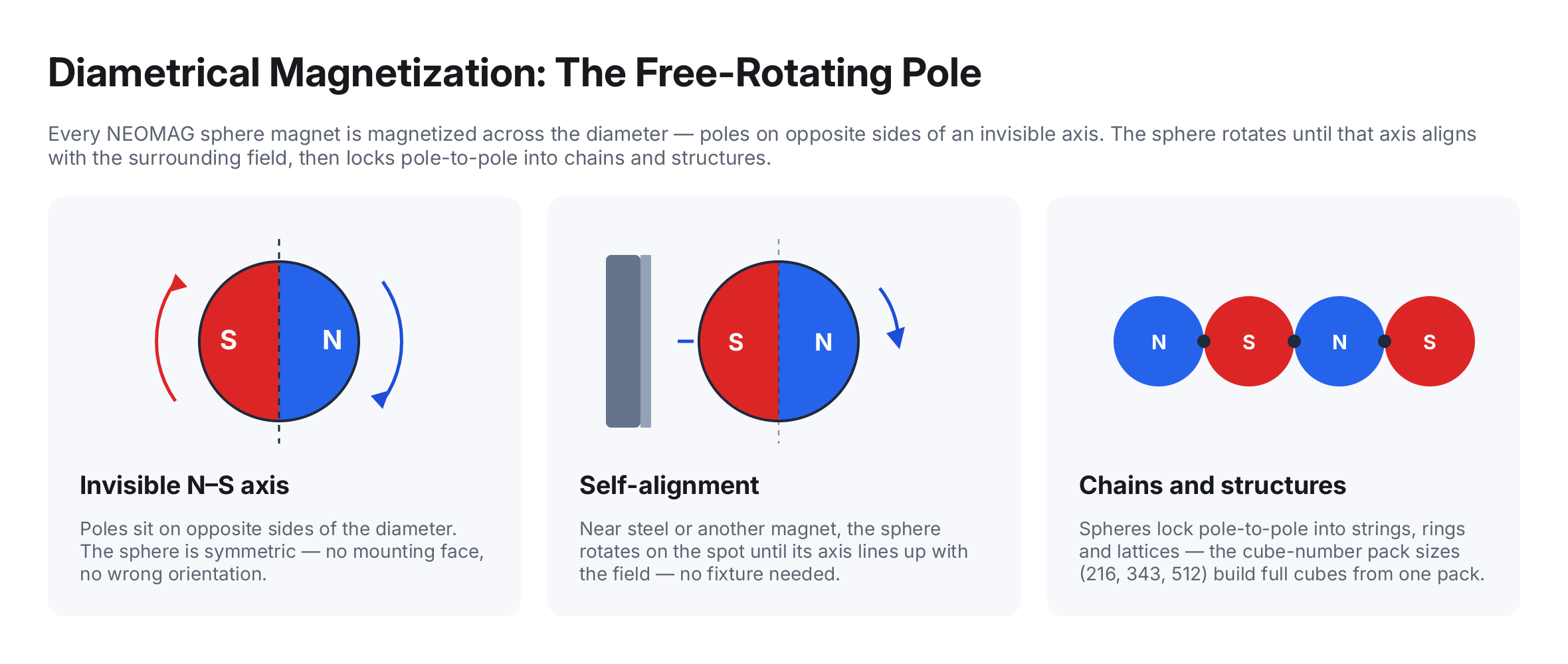
Neodymium sphere magnets are diametrically magnetized as standard: the north and south poles sit on opposite sides of the sphere, on an axis through the diameter. Geometrically that axis is invisible — which is the whole point.
The underlying physics is the same principle described in orientation and magnetization of NdFeB magnets and magnetic field orientation of sintered NdFeB: diametrical magnetization turns each neodymium sphere magnet into a small magnetic dipole that is free to rotate — the only shape in the catalog that can.
One practical note for neodymium sphere magnets: the pole axis is unmarked. If your application needs a known pole direction (a sensor trigger, for example), ask for marked or custom-magnetized spheres through custom magnets.
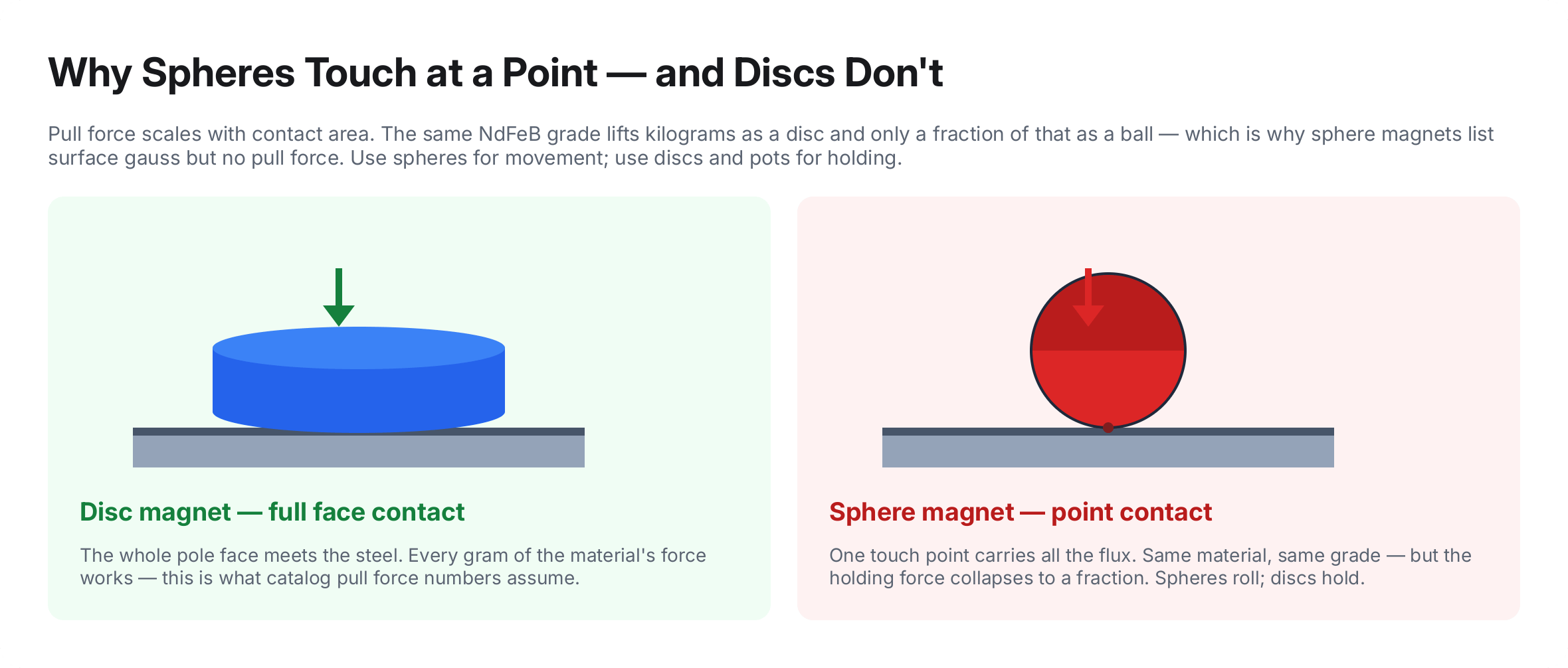
Here is the honest engineering answer that most sphere magnet pages skip: a sphere is a poor holding magnet, and our catalog says so by omission — the product pages list surface gauss (3,100 Gs) but no pull force figure.
The reason is contact area. Pull force scales with how much of the pole face touches the workpiece:
So the same NdFeB grade that lifts kilograms as a disc delivers only a fraction of that as a ball — which is why neodymium sphere magnets list gauss but no pull force anywhere in the catalog. If your job is holding, mounting or clamping, the right shapes are disc magnets, block magnets or pot magnets. Spheres win when you need movement, alignment, demonstration or construction — not static holding.
The contact-area principle behind this is the same one explained in identical performance and volume, different suction force, and the point-reading caveat in how to measure surface gauss with a gaussmeter applies doubly here: 3,100 Gs at the sphere's surface tells you the material is strong, not what it will lift.
The magnet shapes guide compares all families in one table.
Stock neodymium sphere magnets come in the standard N-grade families — see grades and magnetic properties of sintered NdFeB and N35 vs N42 vs N52 explained:
| Suffix | Max operating temperature |
|---|---|
| (none) | 80 °C |
| M | 100 °C |
| H | 120 °C |
| SH | 150 °C |
| UH | 180 °C |
| EH | 200 °C |
Reversible pull loss starts well below the Curie point (~310 °C) — background in Curie temperature and operating temperature of magnets and temperature stability of permanent magnets. For desk and classroom use, temperature is a non-issue; for R&D rigs near heat sources, specify the suffix in the RFQ.
Two standard finishes for neodymium sphere magnets:
Color coatings are slightly softer than bare nickel — expect visible wear on heavily used sets long before the magnet itself weakens.
Neodymium sphere magnets show up wherever movement and alignment beat brute holding force:
Broader industrial context: 15 key industrial NdFeB applications.
Neodymium sphere magnets concentrate strong force into a small, smooth, rolling body — a combination that needs more care than any other shape:
Magnet safety handling rules for the whole range are summarized in our key terms and handling guide.
Eight items settle an RFQ — the procurement requirement checklist walks through each:
If you need marked poles, other diameters or branded colors, start from custom magnets rather than forcing stock parts.
A 5 mm diameter series in two finishes — silver Ni-Cu-Ni and multi-color — in packs from 36 to 1,000 pieces. See the size tables above. Other diameters are custom-made.
Yes — every stock sphere is diametrically magnetized, poles on opposite sides of an invisible axis. That is what lets spheres rotate freely, self-align and form chains. Background in magnetization characteristics.
It reads ~3,100 Gs at the surface — strong for its size — but spheres are not rated with a pull force because they contact steel at a single point. For holding tasks use a disc or pot magnet; the physics is explained in why spheres don't list pull force.
Poorly. Point contact wastes most of the material's force. Spheres are built for movement, alignment, demonstration and construction — not static holding.
Each sphere is a magnetic dipole that rotates to align with its neighbors; pole-to-pole attraction locks them into strings and larger structures. Cube-number pack sizes (216 = 6³, 343 = 7³) let you build complete cubes from one pack.
A color-coded polymer layer over the standard nickel (Ni-Cu-Ni) stack — functional color for patterns, teaching and design matching, not just decoration. See coatings.
They demand more care than any other shape: serious swallowing hazard (two swallowed spheres can pinch through tissue), pinch points when chains snap together, and brittle-plating chipping on impact. Read the safety section before classroom or gift use.
N35–N42 covers education and construction at the best price; N52 buys the strongest field from the same 5 mm body — see N35 vs N42 vs N52.
Yes — pack sizes run from 36 to 1,000 pieces with tiered pricing and live stock in the sphere magnets category. Larger volumes and custom colors are quoted per run.
Yes, as custom parts — other diameters, pole-marked spheres for sensor work, and branded colors. Start from custom magnets; note the pole direction must be set at magnetization and cannot be changed afterwards.
Browse the full range of neodymium sphere magnets for stock packs, or take your drawing to custom magnets for custom diameters and colors. For the other shapes in the family, start at neodymium magnets learn more.